Snook harvest in the Florida Keys closes on Tuesday, December 1, 2026. When we checked on October 21, 2026, 41 days of the fall open window remained, counting the check date. The date trips people up because FWC splits the state into snook regions with different closed seasons. We read FWC’s snook regulations page to pin down which one applies here.
The short version, checked October 21, 2026
The Keys follow FWC’s Southwest snook region. Open now through November 30, 2026. Closed December 1 through February 28, 2027; reopens March 1, 2027. Slot 28 to 33 inches, 1 per person per day, license plus snook permit, hook and line. Tarpon and bonefish: release them.
Why the Keys use Southwest rules
FWC places the Florida Keys in its Southwest snook region, which it says runs from near Vanderbilt Beach Rd in Collier County through the Florida Keys to the Monroe/Miami-Dade line. The Village says Islamorada sits in the middle of the Florida Keys, between MM 90.0 and MM 72.6, so it is inside that region.
- FWC places the Florida Keys in its Southwest snook region, which runs from near Vanderbilt Beach Rd in Collier County through the Florida Keys to the Monroe/Miami-Dade line. FWC: Snook recreational regulations
- The Village says Islamorada sits in the middle of the Florida Keys, between Mile Marker 90.0 and Mile Marker 72.6 on U.S. Highway 1. Islamorada, Village of Islands: Why Islamorada Matters
FWC’s Atlantic or Southeast region closes on different dates, and a page written for it will give you the wrong season for the Keys. We do not print those dates here so they cannot be mixed up. If a chart, app or tackle shop sign shows a December closure date other than December 1, check which region it is for.
Closed and open windows
- Open now: October 1 to November 30. The last open day this fall is Monday, November 30, 2026.
- Closed: December 1 to the end of February. This winter that is Tuesday, December 1, 2026 through Sunday, February 28, 2027, 90 days by our count.
- Open: March 1 to April 30. In 2027 that is Monday, March 1 through Friday, April 30, 61 days.
- Closed: May 1 to September 30.
- In the Southwest region FWC closes snook harvest December 1 to the end of February and May 1 to September 30, with a 28 to 33 inch slot and 1 fish per person per day. FWC: Snook recreational regulations
Added up across 2027, the Southwest windows leave snook harvest open on 122 of 365 days by our count, and closed on the other 243. FWC’s notes, as our season records carry them, say catch and release in the closed season still needs a license and a snook permit. The season and date checker shows the status on any date.
Slot, limit and permit
In the Southwest region FWC sets a 28 to 33 inch slot and 1 fish per person per day. You need a snook permit plus a recreational fishing license, including when fishing from shore, and snook may be taken by hook and line, nothing else. Youth under 16 are exempt from the license and the snook permit.
- FWC requires a snook permit plus a recreational fishing license, including for shoreline fishing; hook and line only. FWC: Snook recreational regulations
- FWC exempts youth under 16 from recreational fishing licenses and snook and lobster permits. FWC: Do I need a license or permit?
FWC lists the snook permit at $10.00 a year, in addition to a saltwater license, and non-resident saltwater licenses at $17.00 for 3 days, $30.00 for 7 days and $47.00 annual. By our arithmetic a visitor on a 7-day license plus the permit pays $40.00. FWC lists the no-cost shoreline-only license as a resident license, and it did not list a non-resident shoreline option when we checked, which we mark as not confirmed. Do not assume fishing from a bridge or a beach is free of license rules.
- FWC lists a snook permit at $10.00 a year and a spiny lobster permit at $5.00 a year, both in addition to a saltwater license. FWC: Recreational Saltwater Licenses & Permits
- FWC lists non-resident saltwater fishing licenses at $47.00 annual, $17.00 for 3 days and $30.00 for 7 days. FWC: Recreational Saltwater Licenses & Permits
- FWC lists a Resident Annual Saltwater Shoreline-Only license at no cost; it is not valid from a vessel, from a shoreline reached by vessel, or when swimming or diving. FWC: Recreational Saltwater Licenses & Permits
- FWC's license page lists the no-cost shoreline-only saltwater license as a resident license; it did not list a non-resident shoreline option when we checked on October 21, 2026. FWC: Recreational Saltwater Licenses & Permits
Tarpon: release, and keep big fish in the water
FWC says tarpon is a catch-and-release only fishery. Tarpon over 40 inches must remain in the water unless the angler is pursuing a record with a tarpon tag. FWC allows one tag per person per year when pursuing a Florida state or world record, and lists the annual tag at $51.50, sold at tax collector’s offices, with no exemptions.
- FWC says tarpon is a catch-and-release only fishery; one tarpon tag per person per year may be bought when pursuing a Florida state or world record. FWC: Tarpon recreational regulations
- FWC says tarpon over 40 inches must remain in the water unless the angler is pursuing a record with a tarpon tag. FWC: Tarpon recreational regulations
- FWC lists the annual tarpon tag at $51.50, available at tax collector's offices only, with no exemptions. FWC: Recreational Saltwater Licenses & Permits
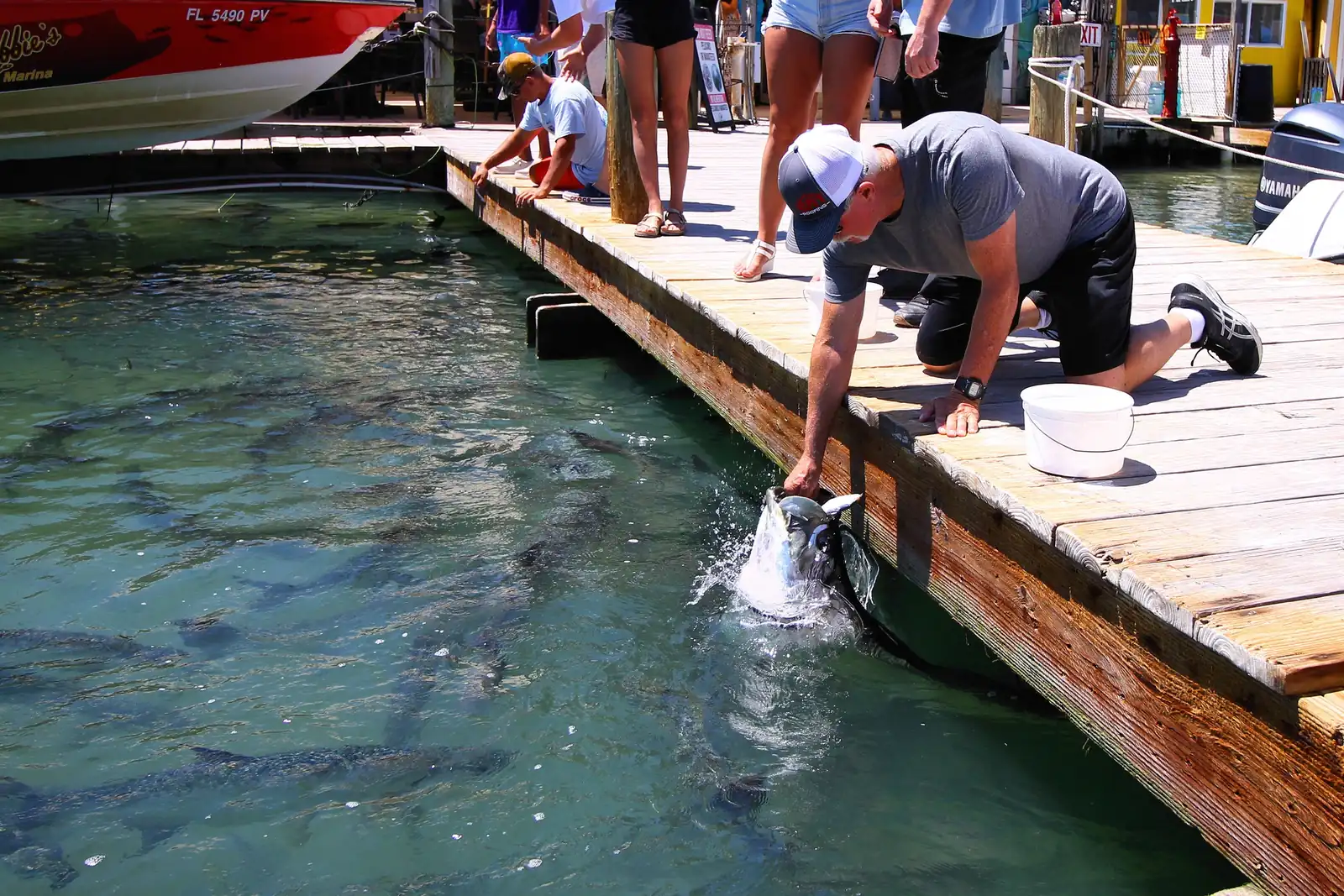
To see tarpon up close without a rod, Robbie’s posts tarpon feeding at $2.50 per person and $5 per bucket of fish, with the tarpon dock open daily 7 am to 9 pm. Robbie’s does not say whether tarpon are there every month, which we mark as not confirmed.
- Robbie's posts tarpon feeding admission at $2.50 per person and $5 per bucket of fish; the tarpon dock is open daily 7 am to 9 pm. Robbie's of Islamorada: Feed the Tarpon
- Robbie's posts tarpon feeding prices and dock hours but does not say whether tarpon are present every month of the year. Robbie's of Islamorada: Feed the Tarpon
Bonefish: release, all year
FWC says bonefish became a catch-and-release only fishery effective September 1, 2013, which makes 13 years as of this fall. It says bonefish can be caught year-round in the Keys, with peak season generally March through October. By our count 11 days of that peak window were left on the check date, running alongside the last weeks of the snook fall window.
- FWC says bonefish became a catch-and-release only fishery effective September 1, 2013. FWC: Bonefish
- FWC says bonefish can be caught year-round in the Keys, with peak season generally March through October. FWC: Bonefish
On a charter
FWC exempts anglers saltwater fishing from a for-hire vessel, such as a guide, charter or party boat, with a valid charter license. FWC also says that if you cast a line, even to catch and release, you need a fishing license. Our research did not record whether the charter exemption covers the snook permit, so ask your captain.
- FWC exempts anglers saltwater fishing from a for-hire vessel (guide, charter, party boat) with a valid charter license. FWC: Do I need a license or permit?
- FWC says that if you cast a line or catch and release, you need a fishing license. FWC: Do I need a license or permit?
Check before you go
Rules change, sometimes by executive order. Read the FWC page again before you go, and if this page and FWC disagree, follow FWC. FWC closed Atlantic state waters to recreational gag grouper by executive order starting August 2, which shows how fast a season can change. The fishing page lists every FWC window we track, and the mile-marker guide helps you find the bridges and shorelines by number.
- FWC lists the Atlantic gag grouper season as May 1 to August 1, and issued an executive order closing Atlantic state waters to recreational gag harvest starting August 2. FWC: Groupers recreational regulations
Snook and fishing questions
Why is Islamorada called the Sportfishing Capital of the World?
The Village says Islamorada is "known by many as the sportfishing capital of the world" and has perhaps the world's highest density of professional offshore charter boats.
Source: Islamorada, Village of Islands: Why Islamorada Matters
Does the Florida Keys tourism council use the sportfishing capital name too?
Yes. The tourism council calls Islamorada "the Sport Fishing Capital of the World," with tarpon, bonefish and sailfish among its draws.
Source: Florida Keys tourism council (visitfloridakeys.com, fla-keys.com redirects here): Islamorada
How much does it cost to feed the tarpon at Robbie's?
Robbie's posts admission at $2.50 per person and $5 per bucket of fish. The tarpon dock is open daily 7 am to 9 pm.
What is a Sanctuary Preservation Area?
NOAA says SPAs protect shallow reefs; there are 17 in the sanctuary covering about 12 square miles. Diving, snorkeling and boating are allowed, but fishing and collecting are not.
Source: NOAA Florida Keys National Marine Sanctuary: Sanctuary Preservation Areas
When is lobster mini season in 2027?
FWC lists the 2027 sport season as July 28 to 29, 2027, the last consecutive Wednesday and Thursday of July.
What is the lobster limit in the Keys during mini season?
FWC sets 6 per person per day in Monroe County and Biscayne National Park during the sport season. Night diving is prohibited in Monroe County during the sport season.
When is regular lobster season?
FWC lists August 6 to March 31, with a daily bag limit of 6 per person.
What do I need to catch lobster?
FWC requires a saltwater fishing license and a lobster permit unless exempt, a measuring device, and a carapace larger than 3 inches measured in the water. Lobster must be landed whole.
When is stone crab season?
FWC lists the state waters season as open October 15 to May 1, closed on May 2.
What are the stone crab claw limits?
FWC sets a 2 7/8 inch claw minimum and 1 gallon of claws per person or 2 gallons per vessel, whichever is less.
When is snook season in the Florida Keys?
FWC puts the Keys in its Southwest snook region, closed December 1 to the end of February and May 1 to September 30. The slot is 28 to 33 inches, 1 per person per day.
Do I need a snook permit?
Yes. FWC requires a snook permit plus a recreational fishing license, including from shore.
Which grouper rules apply in Islamorada?
FWC applies its Atlantic grouper rules to all state waters of Monroe County. Black, red and most shallow-water groupers are open May 1 to December 31.
When is gag grouper open on the Atlantic side?
FWC lists May 1 to August 1, and an executive order closed Atlantic state waters starting August 2.
When can I keep hogfish in the Keys?
FWC says Atlantic rules, which include the Florida Keys, allow hogfish May 1 to October 31, 16 inch fork length minimum, 1 per harvester.
Is mutton snapper open year-round?
FWC lists Atlantic mutton snapper as open year-round, 18 inch total length minimum, 5 per person within the 10 snapper aggregate.
What are the mahi (dolphinfish) limits?
FWC lists Atlantic state waters rules as a 20 inch fork length minimum and 5 per person or 30 per vessel, whichever is less.
Can I keep a tarpon?
FWC says tarpon is catch-and-release only. One tarpon tag per person per year may be bought when pursuing a state or world record.
Can I take a big tarpon out of the water for a photo?
FWC says tarpon over 40 inches must remain in the water unless you are pursuing a record with a tarpon tag.
How much is a tarpon tag?
FWC lists the annual tag at $51.50, available at tax collector's offices only.
Can I keep bonefish?
No. FWC says bonefish became a catch-and-release only fishery on September 1, 2013.
Source: FWC: Bonefish
When is the best bonefish season?
FWC says bonefish can be caught year-round in the Keys, with peak season generally March through October.
Source: FWC: Bonefish
How much is a non-resident saltwater fishing license?
FWC lists $47.00 annual, $17.00 for 3 days and $30.00 for 7 days.
Do I need a license to fish from shore or a bridge?
FWC says you need a license if you cast a line, even for catch and release. Its no-cost shoreline-only license is listed as a resident license.
Do I need my own license on a fishing charter?
FWC exempts anglers fishing from a for-hire vessel (guide, charter, party boat) with a valid charter license.
Do kids need a fishing license?
FWC exempts youth under 16 from recreational fishing licenses and snook and lobster permits.
What is the State Reef Fish Angler designation?
FWC requires this no-cost designation for anglers 16 and older fishing from a private vessel for certain reef fish, including mutton and yellowtail snapper, hogfish and several groupers.
Source: FWC: State Reef Fish Survey
When is the Islamorada Sailfish Tournament?
The organizer says the 63rd tournament fishes December 5 and 6, 2026, with festivities starting December 4.
When is the Fish for Holly Sailfish Tournament?
Fish for Holly says its 9th annual tournament is January 8 to 9, 2027 at Islander Resort, Islamorada.
What other sailfish tournaments are in the Gold Cup?
The tournament site lists the Islamorada Fishing Club Sailfish Tournament on January 20, 2027 and the Cheeca Lodge Presidential on January 23 and 24, 2027.
Written by the Islamorada Guide Editorial Team. Some content may be AI-generated. People check every fact before it publishes.
Dates, rules and hours can change. The organisers have the final word: Village of Islamorada (official site)